 how-to
Hiring Subcontractors for Complex Excavation
Table of Contents
- Understand Your Project Scope and Site Conditions
- Subcontractor Prequalification: What to Evaluate
- Excavation Subcontractor Insurance Requirements
- OSHA Excavation Safety Compliance for Subcontractors
- Essential Questions to Ask Before Hiring
- Subcontractor Agreement for Earthwork Services
- Managing Performance and Mitigating Risk
- Frequently Asked Questions
Last Updated: September 21, 2026
Understand Your Project Scope and Site Conditions
Before hiring excavation subcontractors, understand your project demands and site conditions. Contractors who skip this step receive wildly different bids and face unexpected delays.
Geotechnical Assessment and Subsurface Risk Identification
Get a geotechnical report ($500-$5,000) showing soil type, water table depth, rock formations, and hazards. It saves tens of thousands in unexpected delays and safety incidents.
Review soil classifications in the report. Sandy soils drain quickly but collapse without support; clay is stable but swells when wet; silt looks stable but fails suddenly under load. Note classifications at each depth to determine required equipment and techniques.
Note water table depth. Shallow groundwater requires dewatering equipment (pumps, sumps, French drains), adding cost and complexity. Ask whether seasonal variations affect depth, timing excavation around these patterns reduces dewatering costs.
Identify soil hazards: expansive clays (swell/shrink), collapsible soils (compress when saturated), liquefiable soils (lose strength in earthquakes). Ask subcontractors directly about experience with these conditions, generic excavation experience isn't sufficient.
If contamination is flagged or your site has industrial history, require Phase I and Phase II Environmental Site Assessments. Ask subcontractors about brownfield experience and relationships with environmental contractors and licensed waste disposal facilities.
Ask subcontractors to interpret the geotechnical report. Competent operators reference specific soil classifications, discuss water table implications, and explain adjustments for subsurface conditions. Vague answers are a red flag.
Site Conditions and Logistics Planning
Define scope in writing: grading, utility installation, vegetation clearing, or other work. Scope determines equipment size, crew duration, and risk profile.
Document site access and constraints: equipment reach, temporary roads, overhead power lines, buried utilities, neighboring properties. Ask how the subcontractor will stage equipment and whether they'll need multiple mobilizations or smaller equipment.
Hire a professional survey showing property lines, existing structures, drainage, and slopes. Provide it to all bidders so they estimate the same conditions.
Call 811 before hiring anyone to mark all utilities. Provide the subcontractor with utility maps and as-built drawings. Ask how they'll verify locations during excavation (hand-dig test holes or ground-penetrating radar).
Subcontractor Prequalification: What to Evaluate
Prequalification separates capable operators from those who create headaches. Focus on site-specific capability and safety, not lowest bid.
Technical Expertise and Equipment Capacity
Ask what equipment they own or access. Match equipment to project size, small operators struggle on large sites; oversized equipment on tight lots wastes money and creates safety risks.
Call three to five references. Ask about site conditions, work management, and schedule adherence. Listen for consistent patterns, repeated strengths or problems.
Verify years in business and regional experience. Long-term operators understand local geology, drainage, and seasonal impacts.
Ask about crew size and scalability. One-person operations can't handle complex jobs needing multiple crews.
Technology Integration and Modern Equipment Capabilities
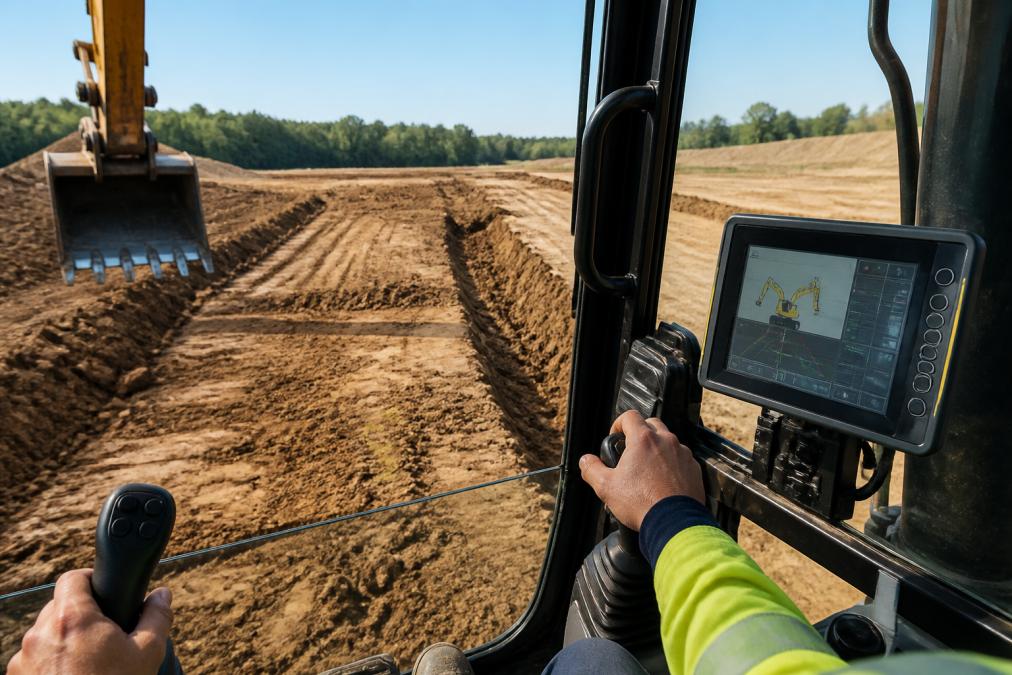
For complex projects, ask about technology capability: GPS-guided grading (maintains precise grades), drone surveying (3D site models), telematics (tracks equipment), ground-penetrating radar (detects utilities), and laser scanning (3D point clouds for confined spaces). Technology is now baseline on complex projects, but only if operators are trained to use it.
Safety Record and Certifications
Request their OSHA record. Have they had citations? How serious? A single minor citation might be acceptable. Multiple serious violations suggest systemic safety problems. You can request this information from OSHA directly through their Establishment Search tool.
Ask if they carry certifications in equipment operation. Heavy equipment operators should have valid certifications. Trenching work requires specific training on trench safety and shoring systems. These certifications aren't optional, they're legal requirements.
Inquire about their safety culture. Do they hold toolbox talks before each shift? Do they have a safety manager on larger projects? Do they use spotters when operating near structures? These practices prevent accidents that kill people and destroy projects.
Check their workers' compensation history. High claim rates suggest either poor safety practices or unreported incidents. Ask for their Experience Modification Rate (EMR) if available. A high EMR means they've had more claims than average for their industry class.
Excavation Subcontractor Insurance Requirements
This is non-negotiable. Get proof of insurance before any work starts. Here's what you need.
General Liability Insurance: Minimum coverage should be $1 million per occurrence. This covers damage to property or injury to third parties. If the subcontractor damages a neighbor's fence or a utility line, general liability pays for it.
Workers' Compensation Insurance: Required by law in most states for any subcontractor with employees. Verify it's active and covers all workers on your site. Ask for a certificate of insurance listing your company as an additional insured.
Equipment Insurance: For subcontractors with owned equipment, verify they carry coverage. This protects against loss if equipment is damaged or stolen on your site.
Pollution Liability: If your site involves contaminated soil or hazardous materials, require pollution liability coverage. This is specialized and many operators don't carry it, but it's essential if there's any environmental risk.
Request certificates of insurance at least two weeks before work begins. Verify the policy dates cover your entire project timeline. Don't accept verbal assurances, get it in writing. If a subcontractor can't provide proof of insurance, they're not ready to work.
OSHA Excavation Safety Compliance for Subcontractors
OSHA standards for excavation work are strict because people die when excavations collapse. Make sure your subcontractor knows and follows them.
Trenches deeper than five feet require a protective system. This means either sloping the walls, installing shoring, or using a trench box. There's no shortcut here. OSHA compliance is mandatory, not optional.
Subcontractors must identify and locate underground utilities before digging. Call 811 (the national "Call Before You Dig" number) at least two business days before excavation starts (811 Before You Dig). Mark all utilities: gas, electric, water, sewer, fiber. One hit on a live power line kills people instantly.
Require atmospheric testing in confined spaces. If workers enter excavations deeper than four feet, the air must be tested for oxygen levels, combustible gases, and toxic substances. This is especially important near contaminated sites or areas with poor ventilation.
Inspect the excavation daily before work starts. Look for cracks, seepage, or signs of instability. After heavy rain, inspect again. Conditions change. What was safe yesterday might be unsafe today.
Enforce fall protection. Workers near excavation edges need guardrails, safety nets, or harnesses depending on the depth and hazard. No exceptions.
Require your subcontractor to have a competent person on site, someone trained to identify hazards and stop work if conditions become unsafe. This person should have OSHA 30-hour training or equivalent.
Essential Questions to Ask Before Hiring
Ask these questions during your initial conversations. The answers tell you whether the subcontractor understands your project.
"How would you handle the soil conditions on this site?" Listen for specific details. Do they mention the geotechnical report? Do they ask about drainage? Or do they give a generic answer? Specificity signals competence.
"What's your mobilization timeline?" A good subcontractor can be on site within one to two weeks. If they're booked for months, you're either hiring too late or they're overcommitted.
"How do you manage change orders?" Excavation projects often reveal surprises. Unexpected rock, contamination, or utility conflicts cost money and time. Ask how they'll handle these. Do they document changes in writing? Do they provide detailed estimates for extras?
"What's your experience with [your specific site condition]?" If your site has rocky soil, ask about their rock excavation experience. If it's near utilities, ask about utility coordination. Match their experience to your needs.
"Can you provide a detailed project schedule?" A professional gives you a written timeline with milestones. If they're vague about duration, they haven't thought it through.
"How do you handle disputes or problems?" Do they have a process for resolving disagreements? Are they willing to work through issues, or do they get defensive? This matters when things go wrong.
"What's your payment schedule?" Understand upfront whether they want deposits, progress payments, or payment on completion. Clarify what triggers each payment.
Subcontractor Agreement for Earthwork Services
Put everything in writing. A written agreement protects both you and the subcontractor. Here's what your contract must cover.
Scope of Work: Describe exactly what the subcontractor will do. Include site preparation, excavation depth, grading specifications, and material removal. Be specific. "Clear the site" is vague. "Remove vegetation down to six inches below grade, excavate to elevation 542.5 feet, and haul material to the approved dump site" is clear.
Timeline and Milestones: State the start date, expected completion date, and key milestones. Include consequences for delays. Will you charge daily penalties if work extends beyond the deadline? Will weather delays extend the timeline?
Payment Terms: Define the price, payment schedule, and what triggers each payment. Example: 25% deposit, 50% upon reaching halfway completion, 25% upon final inspection and approval.
Insurance and Liability: Require the subcontractor to maintain insurance and name your company as an additional insured. Specify who's liable if equipment damages property or someone gets injured.
Change Order Process: Describe how extra work gets approved and paid.
Managing Performance and Mitigating Risk
Once work starts, your job isn't finished. Active management prevents problems from becoming disasters.
Frequently Asked Questions
What insurance requirements should I verify before hiring an excavation subcontractor?
Require workers' compensation insurance, general liability coverage of at least $1 million, and equipment insurance. Ask for certificates of insurance naming you as an additional insured. Verify coverage is active before work begins and that the policy covers the specific scope of your excavation project. Check that liability limits match your project's risk profile.
How do I evaluate the safety record of an excavation subcontractor?
Request their OSHA recordkeeping history and ask about any past citations or incidents. Verify they have a written safety plan and that crew members hold relevant certifications like OSHA 30-hour cards. Ask for references from recent projects and contact those clients about safety performance. A strong safety record reflects their commitment to compliance and reduces your liability exposure.
What are the key components of a solid excavation subcontracting agreement?
Include detailed scope of work, project timeline with milestones, pricing structure and payment terms, insurance and bonding requirements, safety protocols and OSHA compliance obligations, change order procedures, and dispute resolution framework. Specify liability limits, warranty periods, and how subsurface hazards or unexpected conditions will be handled. Define site mobilization requirements and equipment specifications.
How do I ensure compliance with OSHA excavation standards when using subcontractors?
Require subcontractors to follow OSHA trenching and excavation standards, including proper shoring, sloping, and protective systems. Conduct a pre-work safety meeting covering hazard identification, utility locating procedures, and emergency protocols. Perform regular site inspections to verify compliance. Include OSHA compliance language in your subcontractor agreement and hold them accountable for violations that could expose your project to regulatory action.